Wednesday, August 10, 2011

Andrew's Birthday day!

August 10, 2011

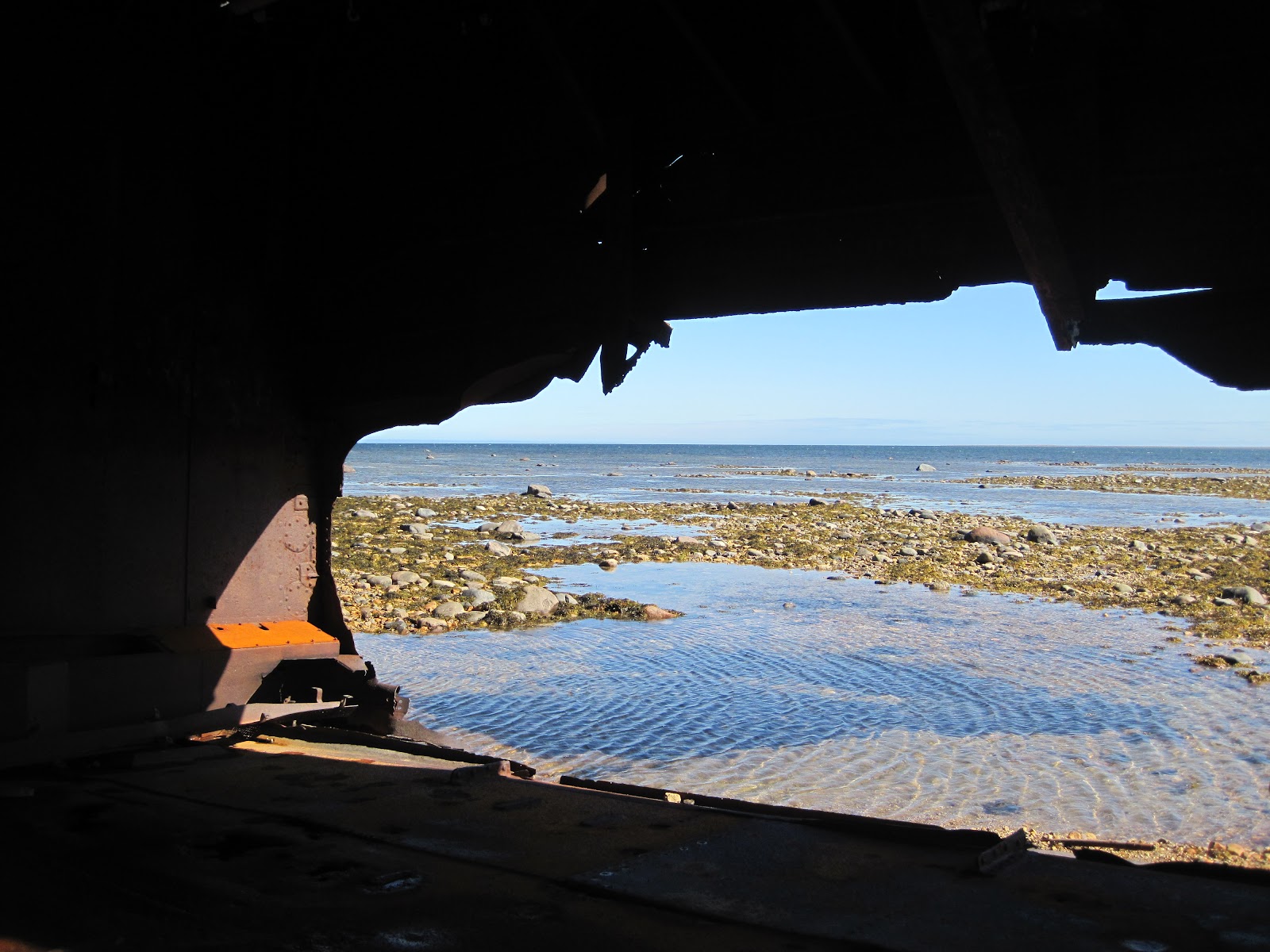
Picture this. You are standing by a boat where six and a half hours earlier, you would have been completely submerged. This was where we were standing this morning: by the Ithaca, which is a single hull riveted ship. The Ithaca was an ore ship that sank in September of 1960. One of the theories regarding how it sank was that it was purposely grounded during a vicious storm, but since it was insured the captain was not too worried about leaving it there. 
The group standing inside the Ithaca
Looking out towards the water from inside the Ithaca
Greg’s footnote: For his 17th birthday, Andrew got a very pricey gift from the group... A live, two centimetre long krill found under a rock during our time at the Ithaca. In short, he ate it. Live.

It was a very rusty and old boat that took a lot of effort to get to. Since the beach was covered by the tide, there were a lot of rocks with slippery seaweed attached to them, as well as lots of puddles everywhere. Unfortunately, if you did not have rubber boots on, your feet got pretty wet.

Larissa standing in one of the many puddles
Greg’s footnote: Shawna fell backwards into a puddle during our escapade back from the Ithaca. It was hilarious.

After we ate lunch, we went to Cape Merry and were separated into groups of two for a study on the beluga whale population. We sat watching our assigned zones for two hours, recording numbers every tenth minute. It was windy and quite cold but it was an exciting experience trying to spot the ridges of the belugas.

Greg’s footnote: Emma and Andrew were by far the most successful. They found fifty WHOLE fiftieths of a full beluga. In case you were wondering, they found one beluga whale.

Once this two hour excursion was over, we headed off to Churchill to explore the area and buy souvenirs. 
At a park in Churchill before we headed off to dinner
Dinner at Gypsy’s was great and everyone enjoyed the food. Andrew got two more gifts from the group- one, a card signed by each of us, and two, a Nanaimo bar as a replacement for birthday cake. The best part was that all of this was on Doug’s tab! After dinner, we made our way to visit Cape Merry.
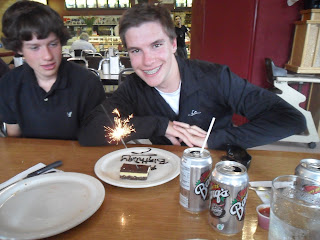
Andrew with his "birthday cake"
Greg’s footnote: At dinner, Larissa ate an entire 12-inch pizza, and to this point of the night has not yet thrown up.

At Cape Merry, we learned about edible plants that can be found in the Churchill tundra area. Listed are some of the more interesting and delicious plants that are seen throughout Churchill: fireweed (used for jelly, completely edible), Labrador tea (when prepared properly, delicious), sphagnum moss (extremely absorbent, used as bandages), and crowberry (root used as medicine, berry used in jelly and pie).

Sphagnum moss

Fireweed
Greg’s footnote: Troy had previously enjoyed some Labrador tea uncooked and unprepared- not the safest thing to do, but he spat it out after he discovered Harry WASN’T joking about it being poisonous. Also, many of the edible plant samples were consumed by Harry and Troy. Too many :P. 

All in all, it was a great day, filled with lots of interesting information. Happy Birthday Andrew!
Andrew on his 17th birthday
 
By Shawna and Greg

Tuesday, August 9, 2011

In Which We Discover Why This Place is Called a RESEARCH Center


DAY EIGHT
Today began the same as most days. Everybody got up and headed for breakfast, with the slight added problem of a certain song about a certain sea animal ringing in everyone’s ears. On the schedule was meeting with various researchers and learning about what they were doing. Today’s forecast: boredom. Massive boredom, as old dudes in lab coats droned on about numbers no one understood
Instead, we got to meet some really cool people doing really cool things. First was Travis, who is doing a study for his PHD. He’s up here researching the effects of temperature and salinity on a certain type of bug called Chironomids. Turns out they’re everywhere, with some 15000 different species spread all over the world. They’re incredibly numerous, especially near bodies of water. Travis was doing in-vitro experiments (that means in a petri dish) where he would modify the temperature or the salinity of the water and see how the little things reacted.
The reason Travis is doing this research is because Chironomids have always been abundant. And since the shape of the Churchill area with regards to water was shaped by the glaciers of the last ice age, which would have changed the salinity and temperature of the water, he believes we can use the information from the Chironomids to build an image of the area’s evolution as a water system.
Pretty neat stuff!
Next we met Monica and Anne  who were doing research on Araci, also known as mites. They had a lot of pictures but didn’t say as much about their research, but they talked a lot about all sorts of different types of mites. They called them cute. Some agreed. Others did not.
Their research is part of a much larger project attempting to gather a DNA encyclopedia for every species. As such, their job is to identify different types of mites and gather data on them. They gather samples live and dead from all over the place and bring them to the lab in order to do that. They have at least one live specimen they’re hoping will breed, allowing it to be identified via its more unique looking offspring.

They also had these cool leaves that had been used by the mites to make something called galls. These are large pods of flesh that grow around a mite larvae, drawing energy from the plant and giving it to the larvae. It’s really cool, and we got to open some up to see if we could find any larvae. Some of us did.

Pulling larvae out of galls for Anne

Greg showing the fruits of his labour


Then we all have lunch, and then we went  out with another researcher named Anne Corkery.  Instead of sitting in the classroom or the lab, we went out to the tundra. There, she told us about her research on Semipalmated Plovers, a type of shore bird. Anne was researching what the effects of climate change, and the resulting changes in bug patterns, were on the success of the Plover’s breeding season.  She would have to find nests via the bird’s behaviour, then basically stalk the "groundbound" chicks until she could catch and measure them, and mark them for later checking. The data gathered from this could be used to predict the effects of global warming on larger animals, which is pretty clever.

 Anne describing stalking the elusive SP plover. 

After that we spent the afternoon and evening working on assignments. Not the most wild day, but a very productive one!


Adventures in the Sketchmobile with Shaughna and Andrew!

Hello everyone this Shaughna and Andrew!
Once again setting standards from the lovely town of Churchill~!
Today really started in the early hours of the morning (like 1 o’clock) when we all got an amazing chance to see the northern lights. It was cold, buggy and spectacular.  And I spent a lot of the time blinding everyone in the aurora dome with the every now then camera flash. But it was all a good time. 
The Northern Lights!
After rising very early in the morning, we drove away in a van dubbed... well the name isn’t really appropriate for a blog so we shall refer to it as the Sketchmobile! It was a bumpy ride ..... and when I say bumpy, I mean REALLY FREAKEN BUMPY! I was fearing for my life. I think we should have worn helmets.  AAAAAAAAnyway, once we arrived at the forest fire site, we got down to business.  We loaded out of the wonderful Sketchmobile and everyone got into our extremely spiffy looking bug gear, showering ourselves in lots of bug spray. Of course we still managed to amass a huge amount of bug bites.  But the work was very interesting.  We examined several sections of different sections of the forest floor, looking for different species and types of moss and plants that we could identify for part of a lab.  We got to see a lot of the difference species we have been learning about this week as well as getting a chance to find and identify some new ones.
Everyone looking great in their bug gear~!
      
Reindeer Moss!

Then afterwards we got back into the Sketchmobile, and headed off to a healthy full growing boreal forest so we could make a comparison between the two about the number of different species in each. My favourite plant we got to see was the Labrador Tea.  Mine was the reindeer moss.  Once back at the center, we gulped down our lunches very quickly and reviewed what to do for our labs.  Then we worked in the caf for a good three hours .....(in which Harry managed to hurt himself a couple of times and work was not happening as much as we really wanted.)

It's the Sketchmobile!!
The outside
The scary ceiling.
Aaaaaaand the back.

---------------------------------------------------------------------------------------------------------

One of our many views in Churchill

Then after dinner and short bit of free time we got a chance to listen to Caroline, who is a Dene elder speak about her culture and life. She also brought along all kinds of different beaded works and things made of caribou. It’s really cool they use EVERYTHING from the caribou to make stuff.  It is amazing how the Dene use every part of the caribou, from the sinew to the hide.  Nothing is wasted.  We had fun trying on mittens and playing a game that involves pieces of bone and hide on a string attached to another piece of bone. I got the hang of it on the second try! Although others were not as successful *cough*Larissa*cough*hehe. Although Troy found a way to fail but still make it look “stellar”, to quote the man himself.


 Success! for Harry
 Troy shows us how it's done


And now we find ourselves at the end of another fascinating, swaggerific day in Churchill.  We will finish off by listing the many lessons we learned today. 

Lesson #1- When sitting in the back seat of the Sketchmobile, wear a helmet!
Lesson #2- Labrador tea is poisonous, no matter what Harry says. (Troy)
Lesson #3 – When you have TWO FREE HOURS don’t learn the words to a song about  narwhals  (no good can come from this!!!)
Lesson #4- 5 pin bowling was invented in Toronto by a guy from Guelph.
Lesson #5- Peat moss can hold up to 20times its dry weight  in water!!!


These were so soft.
check out my mitts.

This was Andrewand Shaughna signing off from Churchill Manitoba!  


Sunday, August 7, 2011

Day Six in Land of the Polar Bears

We were up late last night
To see the lights
That dance throughout the town.


We then shut our eyes
Until sunny skies
Woke and brought us down.

We all went to class
And then alas
We went to see the lake.

We ventured afloat
In a rubber boat
With whales in our wake.
We set off by foot
On tundra and soot
With photos along the way.


We continued our romp
Surrounding the swamp
Which made for an interesting day.

Four hours past
We were at the fort at last
And they had something to share!

All white and plump
|From the nose to the rump
We had seen our first bear!


From there we venture
Back to the centre
For dinner and homework hooray!

This was Harry and Emma
And this post was our day!

Saturday, August 6, 2011

Museums, Forts and Whales (Oh my!).

We woke up to a much nicer day this morning. The sun was shining, even though it was still chilly to us northerners we ran out in shorts and t-shirts. Our travels started with a trip into town to the Eskimo Museum where we enjoyed authentic Inuit art as well as some fluffy stuffed animals.
An example of Inuit sculptures, animals are a big theme in thier art
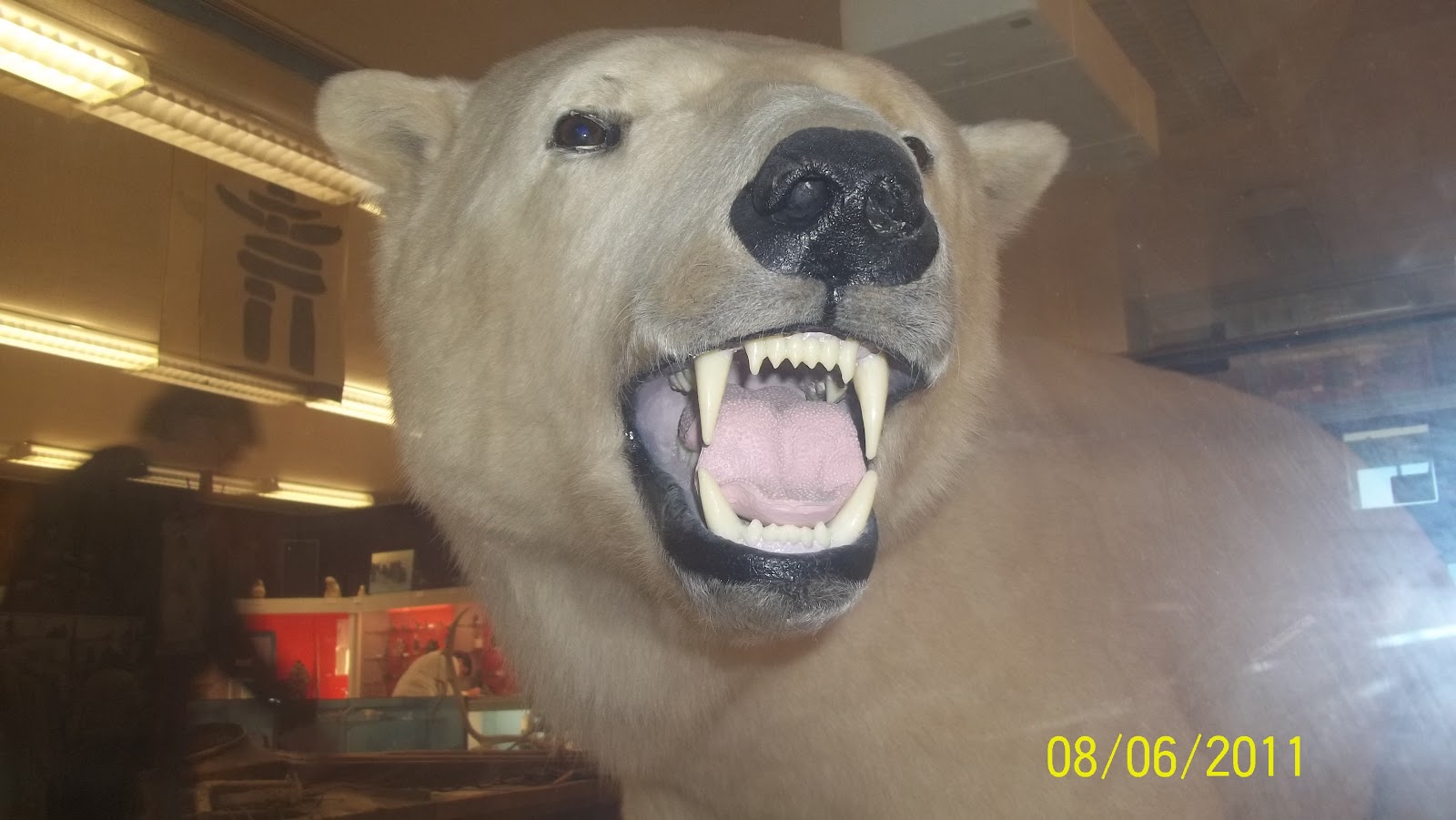
A big fluffy cuddle buddy. (a stuffed polar bear)

Harry, after a very long night. (More Inuit sculpture) 

An arctic wolf.

An arctic fox.
 After our visit to the Eskimo Museum, we hopped onto the ferry to visit Fort Prince of Wales. The fort was set up by the Hudson Bay Company in 1731. The fort was held for many years before the second governor Samuel Hearne, who had large pet beaver living with him in his office, surrendered the fort to the French. The French disabled the fort’s cannons and destroyed the fragile parts of the fort, leaving only the large stone walls. As we ascended to the top floor of the fort, we had a magnificent view of the Hudson Bay where it met the Churchill River. From here we could see a preview of what the ferry ride back would allow us to experience, a bunch of belugas surfacing.
The Far Northers with the Fort Prince of Wales in the background.

The Fort Prince of Wales.
On our ride back to Churchill, we crossed the river via ferry, where we saw an incredible number of beluga whales. The number of whales we saw was incredible. There were tons of whales. We saw pods of 7 or 8 whales at a time circling and descending under our boat, surfacing very often. We were lucky to hear the whale songs from a microphone on the ferry. On our way to the shore, we saw what seemed like an army of hundreds of belugas of all ages and sizes around the boat. The babies were a tan-beige colour, while the cubs were grey and the adults were a bright white. We even saw a seal or two.
A few pictures of our Beluga adventures.


Sitting on the Ferry, having fun spotting whales.

After returning to the center, we had a lesson on GPS navigation. Using this knowledge, we went out to an open patch of tundra, where we had a GPS scavenger hunt. After fending off the swarms of mosquitoes, our first real encounter with the mass of bugs in Churchill, getting wet in the tundra bog, and finding clues we found using GPS co-ordinates, we raced to decipher a coded message. Liam was the first to successfully decode the message, shortly followed by the football team of Emma, Greg and Shawna. In the end we were all winners and won a prize of a thousand mosquito bites and one lollipop each.
After a long day of adventure we all headed back to the center, to get ready for another big day.
Signed Eric and Larissa.

Friday, August 5, 2011

Our first day of exploration in Churchill

August 5, 2011


It was refreshing waking up well rested, on a bed, on solid ground. Although we miss the train, we are all excited to start our journey in Churchill!
Today was a rainy, windy, cold day but everyone was hyped to go exploring. Suited up in our rain jackets and lots of layers (except for Greg and Harry :P) we headed out to our first site: the twin golf balls. The twin golf balls are a structure used by the military as a radar base for rocket research in the 70s. It’s called the twin golf balls because of the large, golf ball-shaped canvas structure protecting the radar dishes from the elements.
The twin golf balls
We stopped here to begin our instruction on plant identification.

Trying to identify plants

Here are the few plant species that we can identify:
Fireweed
Alpine Arnica
Mountain Aven
Our next stop was Miss Piggy. Now before you think it is a big structure of Miss Piggy from the Muppets, take a look at the picture below.
Miss Piggy
Miss Piggy turned out to be a cargo plane that had crashed because it was overloaded. The story goes that the pilot realized during his flight that the plane was overloaded and tried to turn around to land on the tarmac but it was too late and it fell from the sky and landed where it sits today, on the rocks. Even though they crashed, the pilot and co-pilot were unharmed and, amazingly, the cargo was undamaged.
All of us in front of Miss Piggy
Next we moved on to the beautiful but small town of Churchill. There we stopped and acted like the tourists we are by taking lots of pictures and visiting gift shops.
Here is Greg getting eaten by a ceramic polar bear,
all of us feigning shock
After we explored the town, we had the chance to explore a beach that was behind the town community complex.
Posing for a picture on the beach - Shaughna, Eric, Emma, Liam, Troy and Shawna
Next we were off to Cape Merry, one of many national park sites around the Churchill area. Cape Merry was a gun battery defending Fort Prince of Wales. From here, we had a good view of the bay area where belugas usually swim during high tide. Unfortunately, we were unable to spot the ridges of the belugas due to the wave crests being the same colour as them. 
Standing around the cannon at Cape Merry
The next stop was a more somber one because we visited the memorial of to the Dene Village. The Dene people were relocated in 1956, away from the caribou lands to Churchill, where they lived in tents and shanties. The removal from their native lands and their loss of lifestyle took its toll on the Dene.
Looking at the memorial, seeing all those names, seeing that some of them were mere infants was upsetting. After the relocation, the population of the Dene was decimated by more than a third. The memorial was established in remembrance of this tragedy. Since this tragedy, the Dene have returned to their ancestral lifestyle in a new village outside of Churchill.
Next we got to see the bear jail were they keep the bears that are causing trouble in order to relocate them in the wild. Unfortunately we did not get to see any of the inmatesL!
The polar bear traps
Warning sign
After a full day of exploring Churchill, we returned to the centre to continue our lessons.


By Shawna and Eric

Thursday, August 4, 2011

Day One

Today is August 4th of 2011. This year’s Far Northers got in to Churchill earlier today after a gruelling 48 hour train ride, 3 hour flight, and varying lengths of car rides immediately prior to the flight. That adds up to a minimum of 51 hours. When was the last time you spent 51 hours doing the same thing? (Personally, it was when I watched all eight Potter movies back-to-back-to-back-to-etc.)

The train ride was exciting once it got started, but looked dull and boring from the outside. The hot muffins were especially delicious, though some enjoyed them more than others. Same with the cheese. Regardless, the flatness of the land was intriguing for the first while but lost its lustre after the next while. The scenery changed overnight- both nights- and thus we saw the results but not the transitions. It was certainly surprising to see such diversity and variation in a land that we all thought was going to be boring. ­­At the end of it all, we were very disappointed when a certain porter refused to take a souvenir photo with his biggest fans.


The entire group minus Harry, the generous photo-taker, in Thompson, Manitoba.

Most of the group was taken aback by the reality of Churchill as opposed to their preconceptions of the town. It was smaller than expected to some, bigger than expected to others, and more modern than expected to the rest. Since we haven’t explored the town yet, that’s about all we know.


Working together on the train- Greg, Emma and Shawna.


The Northern Studies Centre could easily be compared to a jail- we are locked in, get food at a certain time, and on the old building the windows had fencing on them- but we have found the new facilities here to be cutting edge and quite simply NEW. It is a very environmentally friendly building, and one in which the showers are indescribably marvellous after 51 hours of travelling.

As an aside, I just looked outside and saw, no word of a lie, 50 mosquitoes buzzing right in front of the second floor window. With that, the day comes to a close- though it will be hours until the sun goes down.

Greg and Troy
(or Troy and Greg. We don’t know which should come first, me or him.)


Emma is SUCH a Sleeping Beauty. (An eyes-open, drooling, sleeping beauty.)